

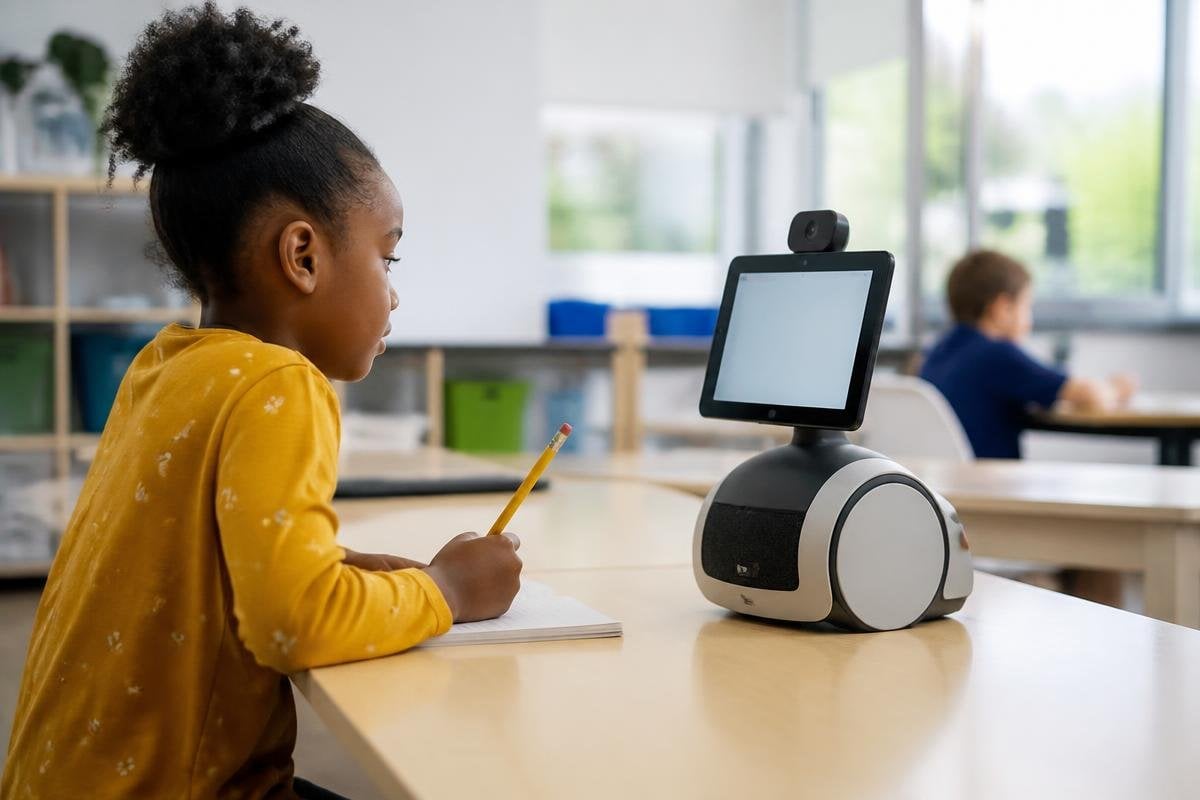
A robot tutor can repeat a maths problem, listen to an answer, and adjust the next task without tiring. That could give a learner more practice, but the value depends on the lesson design, the teacher’s role, and how the system handles a child’s data.
- Possible benefit: steady practice at the learner’s pace
- Main risk: wrong feedback can become a repeated lesson
- Buying test: ask what the robot measures, stores, and lets a teacher change
What a robot tutor can do
A robot tutor usually combines a screen or speaker with software that gives questions and responds to answers. Some systems may also use a camera, microphone, or touch sensor to read a learner’s response. The exact setup matters because each sensor adds another source of personal information.
Repeated practice is the clearest possible benefit. A learner can ask for the same explanation again, work through another problem, or pause without feeling rushed by a class timetable. That can help when a teacher has limited time for one-to-one support.
The machine can also keep the lesson at a steady pace. A learner who needs more work on fractions could receive more fraction problems before moving on. That only helps if the software spots the actual error instead of treating every wrong answer as the same problem.
A teacher remains necessary. They can see whether the learner understands the idea, feels stuck, or needs a different explanation. The tutor can record an answer, but it can’t reliably read every reason behind that answer from a voice, face, or button press.
Where the risks begin
Wrong feedback is the first practical risk. If the system marks a correct answer as wrong, or gives an unclear explanation, the learner may practise the wrong method. Repetition makes that problem harder to notice because the lesson can feel consistent even when its judgment is poor.
Privacy creates a second risk. A tutor may handle names, spoken answers, lesson records, camera images, or notes about progress. Before a school or family buys one, they need clear answers about where that information goes, how long it stays there, and who can see it.
The system can also change how a learner asks for help. Some children may speak more freely to a machine than to an adult. Others may avoid it because its voice, movement, or error messages feel uncomfortable.
The same design won’t suit every learner, so the system needs a way to pause, switch modes, or hand the lesson back to a person. Cost and upkeep matter too. A school may pay for the robot, software access, charging equipment, repairs, and staff training.
A school should record the robot model and the time needed to fix each fault. Staff also need a clear contact when a software update changes the lesson method or stops the robot from working. Reports on tutor robots can add named products and test details before the article turns to what these systems still have to prove.
What has not been proven
More practice from a tutor robot does not prove better learning. A real test would need to measure the learner’s work before and after using the system, compare the result with another teaching method, and report how many learners completed the trial.
The same care applies to claims about motivation. A child may enjoy a robot during the first lesson and lose interest later. A product video can show a smooth exchange, but it can’t show whether the learner remembers the skill a week later.
The strongest product information should name the lesson tasks, the age range, the test method, and the limits. If a maker gives none of those details, treat claims about learning gains as unproven.
A practical check before use
Use this list before a school, tutor, or family puts a robot in a lesson:
- Name the task: choose one skill the robot will teach and define a correct result.
- Check the handoff: make sure a teacher or parent can stop the lesson and take over.
- Review the data: ask what the system records, where it stores it, and when it deletes it.
- Test wrong answers: watch how the tutor responds to a guess, silence, and a correct answer spoken in an unusual way.
- Plan failure care: keep a paper lesson or another device ready when the robot, network, or software stops.
- Set a review date: compare the learner’s work after several lessons, not only their first reaction.
I’d skip any robot tutor that can’t show its correction rules and data policy in plain language. A machine that explains a lesson but hides its records gives the adult too little control.
The useful next step is a small, supervised trial with one skill, one teacher, and a written record of errors. Until that record shows lasting learning, the robot belongs beside the teacher, not in the teacher’s place.
